


The Jackson County I Know Wasn't There Yet.
I went looking for Jackson County on an 1857 map and found a county I barely recognized. A fascinating map from Dickinson College's House Divided project sent me down this particular rabbit hole, with a little help from Jackson County GIS to find my way back.
An old map, two missing counties and a lake that wasn't there sent me looking for the Jackson County I knew — and wondering how many versions of this place have existed along the way.
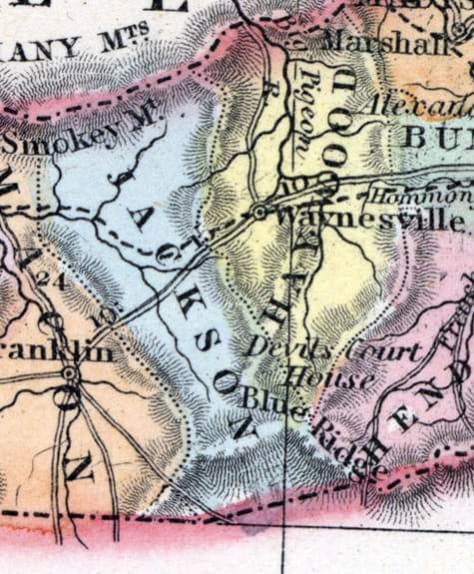
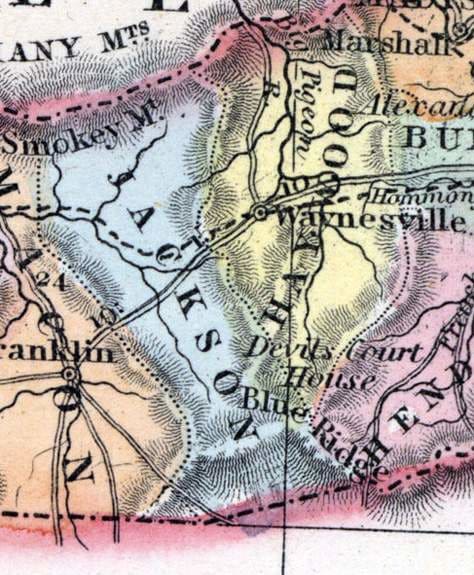
Map source: House Divided: The Civil War Research Engine at Dickinson College
I went looking for Jackson County on a map from 1857 expecting the reassuring little jolt of recognition that comes when you spot a familiar place on an unfamiliar map, and instead, for a moment, I couldn't quite find it.
The name was certainly there, stretched in great big letters across the mountains, and there were enough familiar places around it to help me get my bearings — Franklin down below, Waynesville off to the east, the Smoky Mountains running along the top — but Jackson County itself seemed to have spilled out in directions I wasn't expecting, defying the familiar outline.
I stared at it for a while, trying to make the old map fit the one I carry around in my head, until I did what any of us do when we're trying to figure out where we are and started looking for the neighbors, only to discover that I couldn't find Transylvania County to the east and, when I went looking north for Swain County, I couldn't find that either.
Somewhere between searching the map and wondering what I was missing, it finally occurred to me that the map wasn’t wrong at all; I was simply trying to make the Jackson County on the page fit the Jackson County I know, without realizing that the one I was looking at hadn't finished becoming it yet.
Jackson County was only six years old when this map was published, created in 1851 from portions of Haywood and Macon counties, and the Jackson County spread across that page still included land that would later become part of neighboring counties. Transylvania would be created from portions of Henderson and Jackson in 1861, and another decade would pass before portions of Jackson and Macon became Swain County in 1871, which means someone could have built a house, planted a garden, watched the same mountains from the same front porch and, without moving so much as a fence post, found themselves living in a different county a few years later.
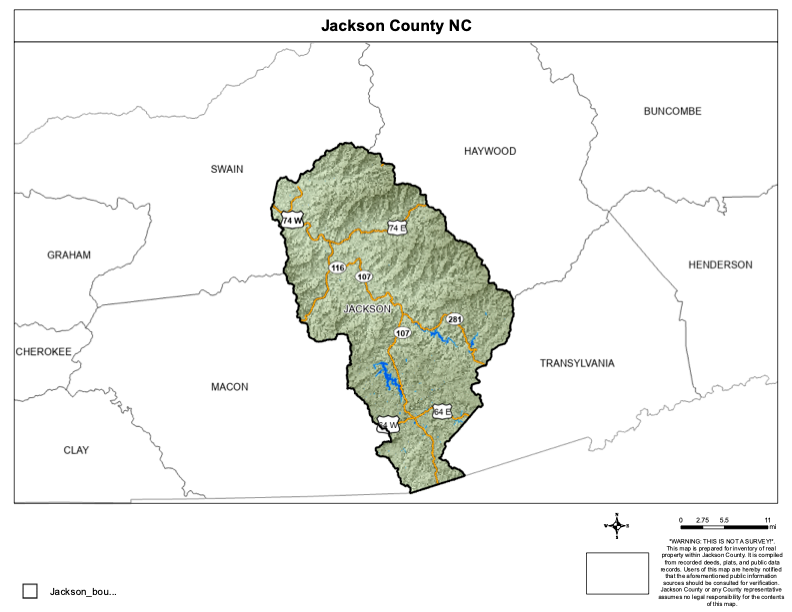 Jackson County today. Map courtesy of Jackson County GIS.
The longer I looked, though, the more the old map quietly turned the question around, because while I've been thinking about all the stories that can fit inside Jackson County's 175 years, I hadn't thought nearly as much about how many different versions of Jackson County have fit inside the same place.
At first I had been studying what had changed, trying to understand where Jackson County ended in 1857 and why those lines didn't match the ones I know today, but somewhere along the way I became more interested in what hadn't changed — the mountains rising beneath those lines and the water moving through them, neither particularly concerned with where one county ended and another began, because those were distinctions we had made, not the landscape.
There aren't many waterways on the map, certainly not enough to represent the creeks and branches that come tumbling and trickling out of seemingly every fold in these mountains, but one long line appears to be the Tuckasegee — the Tuck, as we know it around here — winding through a Jackson County whose boundaries would eventually change around it, and because by then I was looking for water, I caught myself searching for another familiar blue shape before remembering that I was looking for something that couldn't possibly be there.
Lake Glenville didn't exist yet.
There is a whole story beneath that absence, one involving the place that was here before the lake and the changes that eventually put water where this map shows land, and I'm going to leave that story alone for now because it deserves a Thursday of its own.
What interests me here is what the missing lake made me realize: I had started with this map searching for the reassuring landmarks of the Jackson County I know, and somewhere between the county lines that didn't belong where I expected them and a lake that wasn't there at all, I had stopped looking for what I recognized and started wondering about everything that hadn't happened yet.
That changed the map for me, because an old map isn't really a picture of the past in the way I had been thinking about it so much as a picture of one particular moment in a place that was already becoming something else — old counties still waiting to be divided into new ones, roads yet to appear or change course, towns that would grow and communities that would eventually disappear from maps, rivers that hadn't been dammed and valleys that hadn't been flooded, buildings yet to be raised and torn down, names yet to change and boundaries waiting to be redrawn — while generation after generation would become so familiar with the landscape in front of them that their version of it must surely have begun to feel like the permanent one.
And, of course, 1857 wasn't the beginning. Long before there was a Jackson County to put on a map, Cherokee people knew these mountains and waterways, which means even this map, old as it looks to me, captures only one relatively recent moment in a much older human story.
I went looking for Jackson County in 1857 expecting to recognize it, and instead found myself looking at a place caught somewhere between what had already been here for generations and all the things that hadn't happened yet, with no Transylvania County, no Swain County, no Lake Glenville and a county line that no longer exists — while the Tuck, apparently unconcerned with any of it, simply kept finding its way through the mountains.
The Tuck never needed a map.
About the author: Susan Sapienza is Executive Director of the Cashiers Area Chamber of Commerce. She writes about business, community and the connections between people, ideas and places that help shape the Cashiers area and western North Carolina.
Additional Info
Related Links : https://www.linkedin.com/pulse/jackson-county-i-know-wasnt-yet-susan-sapienza-7nrce
Source : https://housedivided.dickinson.edu